
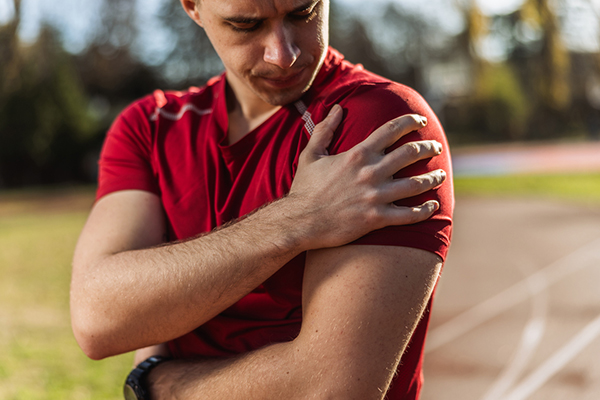
Summer is the peak season for swimmers, baseball players, tennis athletes, and weekend warriors, and unfortunately, it's also prime time for shoulder injuries. A single awkward fall, a hard throw, or one forceful tackle can stretch the shoulder beyond its limits, leaving athletes with persistent instability that sidelines them for months. Here's what athletes need to know about Bankart lesions, shoulder instability, and the Latarjet procedure.
What Is Shoulder Instability and Why Do Summer Athletes Face Higher Risk?
The shoulder (specifically the glenohumeral joint) is the most mobile joint in the human body. This extreme mobility comes at the cost of stability making it the most commonly dislocated joint in the body, a risk that is especially prevalent in young athletes who participate in contact and collision sports.¹
Summer athletes are at particular risk because of the demands of their sport. Shoulder instability can result not only from acute collisions but also from repetitive microtrauma, as seen in overhead athletes participating in baseball, tennis, volleyball, and swimming, and injury in this population can be devastating.² Over time, or after a single traumatic dislocation, the shoulder can lose its ability to stay centered in the socket, resulting in glenohumeral instability.
Recognizing a Bankart Lesion: The Most Common Cause of Recurrent Shoulder Dislocations
When the shoulder dislocates, the humeral head is forced out of the glenoid socket, frequently tearing the labrum. Shoulder dislocations are the most common type of shoulder injury, and between 87% and 100% of anterior dislocations result in a glenoid labrum tear, which is known as a Bankart lesion.³
A Bankart lesion is specifically a tear of the front-lower part of the labrum at the bottom of the socket, typically resulting from an anterior shoulder dislocation when the humeral head comes out of the front of the socket.⁴ Critically, due to lost contact with the surrounding tissue, the Bankart lesion shows no tendency to heal on its own without surgical intervention.⁵
Common signs of a Bankart lesion include:
- A sensation of the shoulder "slipping out" or feeling loose during activity
- Pain with overhead movements or reaching across the body
- A history of one or more shoulder dislocations
- Apprehension or guarding when the arm is raised and rotated outward
- Weakness or numbness following a dislocation event
In younger athletes, the recurrence risk after a first-time dislocation is alarmingly high. Young age under 25 years is a documented risk factor for recurrent shoulder dislocation. A study of athletes from the United States Military Academy documented a 92% recurrence rate in young athletes, and a 72% recurrence rate in those younger than 23 years.⁶ This makes early and accurate diagnosis, as provided by fellowship-trained orthopedic sports medicine surgeon, absolutely critical.
Arthroscopic Bankart Repair: The First Line of Surgical Treatment
For many athletes with an isolated Bankart lesion and sufficient glenoid bone stock, an arthroscopic Bankart repair is the preferred surgical option. Surgical stabilization of acute traumatic shoulder dislocations in adolescent athletes significantly decreases the risk of recurrent instability compared to non-operative therapy, and Bankart repair is currently the treatment of choice, with over 90% of surgeons selecting it as the initial repair for recurrent instability.⁷
Using minimally invasive arthroscopic techniques, the torn labrum is reattached to the glenoid rim with small anchors, restoring the natural bumper that keeps the shoulder joint stable. Recovery typically involves a period of immobilization followed by structured physical therapy to rebuild strength, range of motion, and neuromuscular control.
When Bone Loss Changes the Equation: Understanding the Latarjet Procedure
Not every Bankart lesion can be addressed with a soft tissue repair alone. When recurrent dislocations cause significant bone loss at the front of the glenoid, a standard Bankart repair may not provide sufficient stability. For athletes with glenoid bone defects of 20% or greater, the Latarjet procedure achieves excellent functional outcomes, with the majority of patients returning to their preoperative levels of sports activity and a demonstrably low recurrence rate.⁸
The Latarjet procedure transfers the coracoid process, a small bony projection from the shoulder blade, to the front of the glenoid socket. This simultaneously reconstructs the missing bone and creates a dynamic tendon sling that actively resists forward dislocation. A study showed that in competitive athletes younger than 20 years old with significant glenoid bone loss, the Latarjet procedure resulted in 93% of patients returning to sport, with 84% returning at the same pre-injury level and a recurrence rate of only 3.3%.⁹
Recovery and Return to Sport After Latarjet Surgery
Recovery from the Latarjet procedure may be longer than a standard Bankart repair, but for athletes with significant bone loss, it offers a far more durable long-term outcome. A general timeline looks like this:
- Weeks 0–4: Sling immobilization; gentle pendulum exercises begin
- Weeks 4–8: Passive and active-assisted range of motion exercises
- Months 2–4: Progressive strengthening of the rotator cuff and periscapular muscles
- Months 4–6: Sport-specific training and gradual return to throwing or contact activity
- 6 months+: Full clearance for competitive sport, based on strength and functional testing
Athletes treated by Dr. Anup Shah benefit from a personalized, evidence-based recovery pathway designed to restore shoulder confidence and competitive-level function.
Frequently Asked Questions (FAQ)
What is the difference between a Bankart lesion and a SLAP tear?
A Bankart lesion involves tearing of the front-lower labrum, typically from a dislocation event. Labral tears can also occur at the top of the socket, called a SLAP tear and can also result from repetitive shoulder motion in throwing athletes or weightlifters.⁴ Both conditions can cause shoulder instability but require different surgical approaches based on location and severity.
How do I know if I need a Bankart repair or a Latarjet procedure?
The primary determining factor is the degree of glenoid bone loss. The threshold for "critical" glenoid bone loss, at which the Latarjet procedure is favored over Bankart repair, was initially established at 20–25% and has since been revised to approximately 15% in evolving orthopedic literature.¹⁰ CT imaging and MRI help quantify bone loss and guide surgical planning with Dr. Shah.
Is the Latarjet procedure safe for young athletes?
Yes. Research specifically examining competitive athletes under age 20 found that the Latarjet procedure produced excellent functional outcomes with a recurrence rate of just 3.3%, though it should preferably be performed by experienced surgeons given its technical complexity.⁹
Can shoulder instability be treated without surgery?
In select patients, physical therapy and activity modification may help manage symptoms. However, non-operative management results in significantly higher recurrent instability rates compared to surgical interventions, and operative management should be prioritized for young, athletic patients who present a higher risk of recurrent dislocation.¹¹
Reference Links:
- In-Season Management of Shoulder Instability - PubMed Central
- Shoulder Instability in the Overhead Athlete - PubMed
- Bankart Lesion (Glenoid Labrum Tear): Symptoms & Treatment - Cleveland Clinic
- Shoulder Joint Tear (Glenoid Labrum Tear) - AAOS OrthoInfo
- Bankart Lesion — Overview - ScienceDirect
- A Clinical Review of Return-to-Play Considerations After Anterior Shoulder Dislocation - PubMed Central
- High Rate of Return to Sport in Adolescent Athletes Following Anterior Shoulder Stabilisation - PubMed Central
- Efficacy and Safety of the Latarjet Procedure for Athletes with Glenoid Bone Defects ≥20% - PubMed
- The Latarjet Procedure in Competitive Athletes Younger Than 20 Years Old - PubMed
- The Latarjet Procedure in Patients With Subcritical Glenoid Bone Loss - PubMed Central
- The Role of Early and Delayed Surgery After Anterior Shoulder Dislocation - MDPI Journal of Clinical Medicine
AUTHOR: Anup Shah, MD, MBA, FAAOS - Sports Medicine Orthopedic Surgeon
Anup Shah, MD, MBA, FAAOS is a board-certified, fellowship-trained Sports Medicine Orthopedic surgeon specializing in Knee and Shoulder Surgery in Phoenix, Arizona at Banner Health. Dr. Shah uses a patient-centric and evidence-based approach to help his patients achieve their desired goals.
Credentials & Recognition
Dr. Shah completed an Orthopedic Sports Medicine Fellowship at Baylor College of Medicine and a Shoulder and Elbow Fellowship at Harvard Medical School/Massachusetts General Hospital. He also earned a Master of Business Administration from Rice University. A fellow of the American Academy of Orthopaedic Surgeons with a Certificate of Added Qualification in Sports Medicine, Dr. Shah has authored more than 30 peer-reviewed articles and book chapters and presents nationally and internationally. He remains active in research and education through leadership and committee roles in the American Orthopaedic Society for Sports Medicine and the American Shoulder and Elbow Society and serves as Associate Fellowship Director and Clinical Scholar Facilitator at Banner University Medical Group.
Clinical Expertise
Dr. Shah specializes in minimally invasive arthroscopic surgery of the knee and shoulder, including ACL reconstruction and PCL reconstruction, meniscus and cartilage restoration, patellar instability, knee preservation and revision surgery, rotator cuff and SLAP tear repair, shoulder instability and dislocation treatment, clavicle fractures, shoulder replacement, and complex shoulder reconstruction. He currently serves as a team physician for the Phoenix Suns and Milwaukee Brewers and as head team physician for Paradise Valley and Barry Goldwater High Schools, providing comprehensive sports
Medical Disclaimer: This information is for educational purposes only and does not constitute medical advice. For diagnosis and treatment recommendations, please consult with your healthcare provider.
Content authored by Dr. Anup Shah and verified against official sources.


