
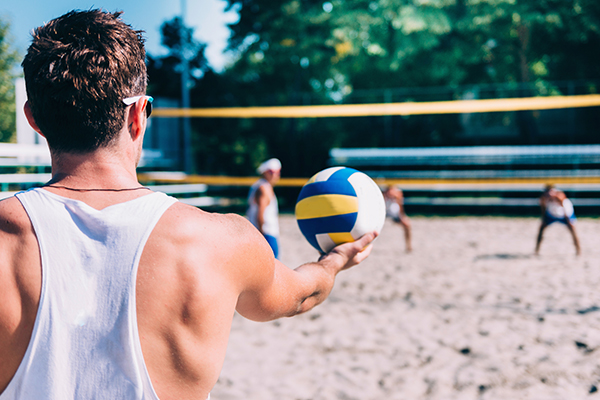
Shoulder pain is one of the most common complaints among overhead athletes, from baseball pitchers and swimmers to tennis players and volleyball players. While the rotator cuff often takes the blame, a critical structure is frequently overlooked. Here is what every overhead athlete needs to know about the biceps tendon and its role in shoulder pain.
What is the Long Head of the Biceps Tendon and why does it matter?
The long head of the biceps tendon (LHBT) originates at the top of the shoulder socket and travels directly through the shoulder joint before exiting into the upper arm. This intra-articular path makes it uniquely vulnerable. With every overhead throw, stroke, or serve, the tendon is subjected to powerful traction, shear, and rotational forces, particularly during the deceleration phase of movement, when stress on the tendon peaks.
Biceps Tendon Injuries Common in Overhead Athletes
Repetitive overhead loading can injure the biceps tendon in several distinct ways. SLAP lesions, tears at the superior labrum where the biceps tendon anchors, are among the most classic overhead-athlete injuries, producing deep shoulder pain and a painful catching sensation. Biceps tendinopathy causes chronic anterior shoulder pain from tendon degeneration, while biceps pulley lesions allow the tendon to slip out of its groove, creating a sharp click with shoulder rotation. These conditions frequently co-occur with rotator cuff pathology, making accurate diagnosis essential.
Red Flags for Biceps Tendon Involvement in Shoulder Pain
Pain during the late cocking or deceleration phase of a throw is a key red flag for biceps tendon involvement and warrants prompt evaluation.
Why Overhead Athletes are at Higher Risk for Biceps Tendon Pain
When the rotator cuff fatigues, a near-inevitable consequence of a heavy training load or long season, the biceps tendon is recruited as a compensatory stabilizer for the humeral head. This dramatically increases the tendon's workload and accelerates wear. Poor scapular mechanics, core weakness, and hip dysfunction can compound this effect by shifting stress up the kinetic chain toward the shoulder.
Signs and Symptoms that Should Not be Ignored
- Anterior shoulder pain along the bicipital groove
- Pain with resisted elbow flexion or forearm supination
- A deep ache or catching sensation during overhead activity
- Shoulder pain that worsens during the follow-through phase of throwing
Treatment Options for Biceps Tendon Shoulder Pain
Many athletes respond well to targeted physical therapy, activity modification, and orthobiologic treatments such as platelet-rich plasma (PRP) injections. When conservative measures are insufficient, arthroscopic procedures, including SLAP repair, biceps tenodesis, or tenotomy, offer reliable outcomes and a high rate of return to sport. The optimal approach depends on the athlete's age, sport, activity demands, and the specific injury pattern identified on imaging.
FAQs
How do I know if my shoulder pain is coming from the biceps tendon?
Pain in the front of the shoulder, especially during overhead motions or the follow-through phase of throwing, along with a clicking or catching sensation, may indicate biceps tendon involvement.
How are rotator cuff tears related to biceps tendon injuries?
The rotator cuff and biceps tendon work together to stabilize the shoulder during overhead activity. When the rotator cuff becomes weak, inflamed, or torn, the biceps tendon often takes on additional stress, increasing the risk of pain, tendinopathy, or labral injuries.
What is the difference between a SLAP tear and a rotator cuff tear?
SLAP tear involves the cartilage and biceps tendon attachment at the top of the shoulder socket, while a rotator cuff tear affects the tendons responsible for lifting and stabilizing the shoulder. These injuries can occur together in overhead athletes.
What activities should I avoid with shoulder pain?
Overhead movements such as throwing, serving, or heavy lifting should be limited until symptoms improve to prevent further irritation of the tendon.
How can overhead athletes reduce the risk of rotator cuff and biceps tendon injuries?
Preventive strategies include maintaining rotator cuff strength, improving scapular mechanics, addressing core and hip stability, avoiding overuse, and allowing adequate recovery between high-intensity throwing or overhead activities.
Reference Links:
AUTHOR: Anup Shah, MD, MBA, FAAOS - Sports Medicine Orthopedic Surgeon
Anup Shah, MD, MBA, FAAOS is a board-certified, fellowship-trained Sports Medicine Orthopedic surgeon specializing in Knee and Shoulder Surgery in Phoenix, Arizona at Banner Health. Dr. Shah uses a patient-centric and evidence-based approach to help his patients achieve their desired goals.
Credentials & Recognition
Dr. Shah completed an Orthopedic Sports Medicine Fellowship at Baylor College of Medicine and a Shoulder and Elbow Fellowship at Harvard Medical School/Massachusetts General Hospital. He also earned a Master of Business Administration from Rice University. A fellow of the American Academy of Orthopaedic Surgeons with a Certificate of Added Qualification in Sports Medicine, Dr. Shah has authored more than 30 peer-reviewed articles and book chapters and presents nationally and internationally. He remains active in research and education through leadership and committee roles in the American Orthopaedic Society for Sports Medicine and the American Shoulder and Elbow Society and serves as Associate Fellowship Director and Clinical Scholar Facilitator at Banner University Medical Group.
Clinical Expertise
Dr. Shah specializes in minimally invasive arthroscopic surgery of the knee and shoulder, including ACL reconstruction and PCL reconstruction, meniscus and cartilage restoration, patellar instability, knee preservation and revision surgery, rotator cuff and SLAP tear repair, shoulder instability and dislocation treatment, clavicle fractures, shoulder replacement, and complex shoulder reconstruction. He currently serves as a team physician for the Phoenix Suns and Milwaukee Brewers and as head team physician for Paradise Valley and Barry Goldwater High Schools, providing comprehensive sports
Medical Disclaimer: This information is for educational purposes only and does not constitute medical advice. For diagnosis and treatment recommendations, please consult with your healthcare provider.
Content authored by Dr. Anup Shah and verified against official sources.


