
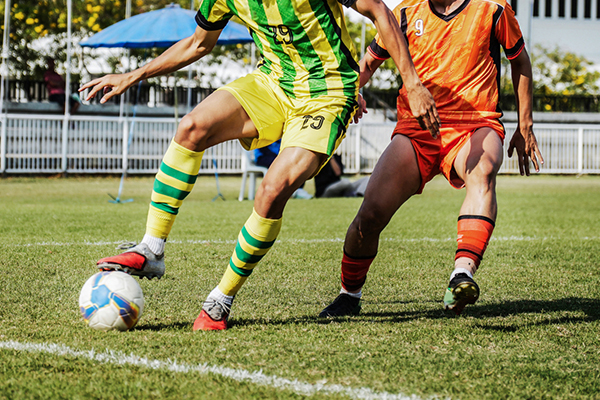
Most men who tear their ACL never saw it coming. They weren't playing professional sports or pushing reckless limits, rather they were playing recreational soccer, landing from a basketball jump, or cutting on a tennis court just like they had hundreds of times before. Here's what every active man needs to know about ACL injuries, risk factors, and when surgery is the right answer.
How Common Are ACL Injuries in Active Men?
ACL injuries are one of the most prevalent orthopedic events in the United States. Research published in PMC/NIH estimates that over 200,000 ACL injuries occur in the US each year, with the vast majority happening during sports activities that involve cutting and pivoting.¹ A systematic review and meta-analysis in PubMed found that 1 in every 50 male athletes ruptures an ACL over the course of their athletic career.² While women face a statistically higher relative risk in certain sports, the sheer volume of male participation in contact and collision sports means that men account for an enormous proportion of total ACL injuries, and a large multicentric study found that males represented 93.1% of total ACL rupture cases in its cohort.³
Why the "I'm in Good Shape" Assumption Is Dangerous in relation to ACL Tears
One of the most persistent myths among active adult men is that fitness and strength alone protect against ACL tears. They don't. The ACL is most commonly torn not through contact, but through the body's own momentum during non-contact mechanisms, such as a sudden deceleration, an awkward landing, or an unanticipated change of direction. Research confirms that non-contact ACL injuries are more prevalent than contact-based ones, commonly resulting from pivoting, landing from a jump, or sudden deceleration without any opposing player making contact.³
Young male athletes are specifically flagged in research as being more susceptible to injuries in high-risk sports involving pivoting and cutting maneuvers such as football and soccer.³ But the risk doesn't disappear with age. Older recreational athletes often have pre-existing muscle imbalances, reduced neuromuscular reaction time, and less structured warm-up habits, all of which increase injury vulnerability.
The Sports That Put Men at Greatest Risk
Not all sports carry equal ACL risk. A systematic review and meta-analysis published in PMC found that ACL injury rates in collision sports for men reached 1.12 per 10,000 athlete-exposures, with contact sports close behind at 0.87 per 10,000. Both sport types are dominated by male participation in the US.⁴ The sports consistently associated with the highest ACL injury rates in males include:
- American football due to player-to-player contact and high-speed direction changes
- Soccer due to cutting and planting on varied surfaces
- Basketball due to jump landings and lateral pivots
- Volleyball due to non-contact landing mechanics
- Downhill skiing due to twisting forces on fixed-foot binding
What Happens to Your Knee, and Your Future, After an ACL Tear
An ACL injury is not just a short-term setback. The long-term consequences are significant and underscore why prompt evaluation and treatment by a specialist matters enormously.
Research published in PMC found that roughly half of ACL-injured knees progress to osteoarthritis within 5 to 15 years of the initial injury.⁵ Additionally, returning to sport too soon dramatically compounds risk. Patients who returned within six months of ACL reconstruction showed a fivefold increase in re-injury risk compared to those who waited eight to twelve months.⁶
ACL Reconstruction: What Men Need to Know About Surgery and Return to Sport
For active adult men who wish to return to cutting and pivoting sports, ACL reconstruction is typically the recommended course of treatment.
Key facts about ACL reconstruction and recovery:
- Most patients can expect to begin sport-specific training between 4 and 6 months post-surgery
- Delaying return to sport until at least 9 months after reconstruction reduces re-injury risk by as much as 51% for each additional month of recovery⁷
- Achieving symmetrical quadriceps strength and passing functional testing milestones before return to sport significantly reduces re-rupture risk
- Meniscus injuries frequently accompany ACL tears (and are present in over 37% of cases in one large study). Addressing both at the time of surgery is critical to protecting long-term joint health³
Early evaluation, appropriate surgical management when indicated, and a disciplined, evidence-based return-to-sport protocol are the factors that most reliably determine whether an ACL injury becomes a temporary setback or a permanent reduction in quality of life.
Frequently Asked Questions (FAQ)
Can an ACL tear heal without surgery?
In some cases, particularly in older, less active patients, non-surgical management with physical therapy and activity modification may be adequate. However, for active men who wish to return to cutting and pivoting sports, ACL reconstruction generally provides the best opportunity to restore knee stability and return to prior activity levels.¹
What does an ACL tear feel like when it happens?
Most people report a sudden pop, immediate pain, and rapid swelling in the knee. The sensation of the knee "giving way" or buckling is also common. These symptoms warrant immediate evaluation by an orthopedic sports medicine specialist.
What is the re-injury rate after ACL reconstruction?
Re-injury rates vary widely depending on return-to-sport timing and rehabilitation quality. One study found that 31.7% of patients experienced either an ipsilateral or contralateral ACL tear post-surgery, with re-injury risk dramatically elevated in those who returned to sport too early.⁶
Does ACL reconstruction prevent arthritis?
ACL reconstruction restores knee stability and enables return to sport, but research is clear that it does not reliably prevent long-term post-traumatic osteoarthritis. Roughly half of ACL-injured knees progress to osteoarthritis within 5 to 15 years regardless of surgical treatment.⁵
Reference Links:
- Anterior Cruciate Ligament Injuries — Return to Preinjury Sports Participation - PubMed Central
- "What's my risk of sustaining an ACL injury while playing sports?" Systematic review with meta-analysis. - PubMed
- Demographic and Injury Characteristics as Potential Risk Factors for ACL Injuries: A Multicentric Cross-Sectional Study - PubMed Central
- ACL Injury Risk in Sport: A Systematic Review and Meta-Analysis by Sex and Sport Classification - PubMed Central
- Osteoarthritis and ACL Reconstruction — Myths and Risks - PubMed Central
- Return to Sport, Re-injury and Performance After ACL Reconstruction - PubMed Central
- Simple Decision Rules Reduce Reinjury Risk After ACL Reconstruction: The Delaware-Oslo ACL Cohort Study - PubMed Central
AUTHOR: Anup Shah, MD, MBA, FAAOS - Sports Medicine Orthopedic Surgeon
Anup Shah, MD, MBA, FAAOS is a board-certified, fellowship-trained Sports Medicine Orthopedic surgeon specializing in Knee and Shoulder Surgery in Phoenix, Arizona at Banner Health. Dr. Shah uses a patient-centric and evidence-based approach to help his patients achieve their desired goals.
Credentials & Recognition
Dr. Shah completed an Orthopedic Sports Medicine Fellowship at Baylor College of Medicine and a Shoulder and Elbow Fellowship at Harvard Medical School/Massachusetts General Hospital. He also earned a Master of Business Administration from Rice University. A fellow of the American Academy of Orthopaedic Surgeons with a Certificate of Added Qualification in Sports Medicine, Dr. Shah has authored more than 30 peer-reviewed articles and book chapters and presents nationally and internationally. He remains active in research and education through leadership and committee roles in the American Orthopaedic Society for Sports Medicine and the American Shoulder and Elbow Society and serves as Associate Fellowship Director and Clinical Scholar Facilitator at Banner University Medical Group.
Clinical Expertise
Dr. Shah specializes in minimally invasive arthroscopic surgery of the knee and shoulder, including ACL reconstruction and PCL reconstruction, meniscus and cartilage restoration, patellar instability, knee preservation and revision surgery, rotator cuff and SLAP tear repair, shoulder instability and dislocation treatment, clavicle fractures, shoulder replacement, and complex shoulder reconstruction. He currently serves as a team physician for the Phoenix Suns and Milwaukee Brewers and as head team physician for Paradise Valley and Barry Goldwater High Schools, providing comprehensive sports
Medical Disclaimer: This information is for educational purposes only and does not constitute medical advice. For diagnosis and treatment recommendations, please consult with your healthcare provider.
Content authored by Dr. Anup Shah and verified against official sources.


