
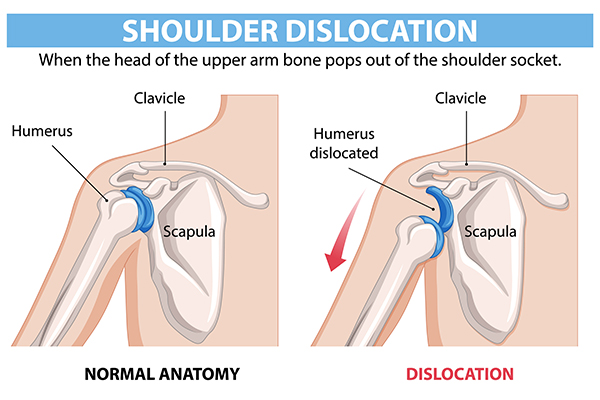
Watching your young athlete clutch their shoulder in pain after a hard collision is every parent’s and coach’s nightmare. While popping the joint back into place provides immediate relief, the true challenge lies in preventing the next occurrence. For active teenagers and young adults, a single dislocation often signals a high risk for future instability. Explore the factors that determine when surgery is the best path forward.
The High Risk of Shoulder Dislocation Recurrence in Young Athletes
In the world of sports medicine, age is one of the most significant predictors of future shoulder trouble. According to research studies, recurrent instability rates are as high as 100% in skeletally immature patients and nearly 96% for adolescents following a traumatic dislocation.1
The reason is anatomical. A dislocation often causes a Bankart lesion, which is a tear in the labrum (the cartilage rim that deepens the shoulder socket). In a developing athlete, this tissue rarely heals back to the bone in a way that provides the necessary tension to hold the humerus in place during high-impact sports.
Evaluating Bone Loss: The "Tracking" Factor
Each time a shoulder dislocates, the ball can "chip" away at the edge of the socket (the glenoid) or create a dent in the back of the humerus (a Hill-Sachs lesion).
If significant bone loss occurs, the shoulder becomes like a golf ball sitting on a flat tee rather than a deep socket. In these cases, traditional arthroscopic repairs might not be enough. Advanced imaging may be needed to determine if the shoulder is off-track, which often tips the scales toward surgical intervention to restore bone or ligamentous stability before permanent damage occurs.
Non-Surgical vs. Surgical: Making the Decision
Not every dislocation requires an immediate trip to the operating room. We often consider non-surgical routes for:
- First-time dislocations in "low-demand" or non-contact athletes.
- Patients with generalized joint laxity (naturally "loose" joints) who respond well to rotator cuff strengthening.
However, surgery is often the right call for:
- Contact Athletes: Football, hockey, and rugby players who cannot avoid high-velocity impact.
- Overhead Athletes: Swimmers or baseball players who require extreme range of motion and stability.
- Recurrent Instability: If the shoulder has "slipped" more than once, the structural damage is likely too great for exercise alone to fix.
Modern Surgical Solutions: Arthroscopy and Beyond
The good news for young athletes is that modern shoulder stabilization is typically minimally invasive. Using a tiny camera and specialized anchors, we can reattach the torn labrum to the bone through small incisions. This restores the "bumper" that keeps the shoulder in place. For more complex cases involving bone loss, procedures like a Latarjet can provide a powerful mechanical block to prevent future dislocations.
The Path Back to the Field After Shoulder Dislocation
The goal of surgery is to return the athlete to their sport with confidence. A successful recovery involves a phased physical therapy program focusing on proprioception, which is the brain's ability to know where the joint is in space. While the recovery timeline is a commitment, usually six to nine months for contact sports, it is a small price to pay for a stable shoulder that will last a lifetime.
Frequently Asked Questions: Shoulder Instability
Can physical therapy alone fix a torn labrum?
Physical therapy is excellent for strengthening the surrounding rotator cuff muscles to help hold the joint in place. However, it cannot physically reattach a torn labrum to the bone. If the structural damage is significant, surgery is usually required to "reset" the anatomy.
What is a "Bankart repair"?
This is the gold-standard minimally invasive procedure for shoulder instability. Using an arthroscope and small anchors, we reattach the torn labrum to the socket, restoring the natural suction and stability of the shoulder joint.
How long is the recovery before returning to sports?
Most athletes return to non-contact training within 3 to 4 months, but full clearance for contact sports like football or wrestling typically takes 6 to 9 months. This time allows the repaired tissue to fully mature and bond to the bone.
What happens if I keep playing with a "loose" shoulder?
Each subsequent dislocation causes more damage, including bone loss on the socket and humerus. Over time, this makes a simple repair much harder and significantly increases the risk of developing early-onset arthritis in the shoulder.
Reference Links:
AUTHOR: Anup Shah, MD, MBA, FAAOS - Sports Medicine Orthopedic Surgeon
Anup Shah, MD, MBA, FAAOS is a board-certified, fellowship-trained Sports Medicine Orthopedic surgeon specializing in Knee and Shoulder Surgery in Phoenix, Arizona at Banner Health. Dr. Shah uses a patient-centric and evidence-based approach to help his patients achieve their desired goals.
Credentials & Recognition
Dr. Shah completed an Orthopedic Sports Medicine Fellowship at Baylor College of Medicine and a Shoulder and Elbow Fellowship at Harvard Medical School/Massachusetts General Hospital. He also earned a Master of Business Administration from Rice University. A fellow of the American Academy of Orthopaedic Surgeons with a Certificate of Added Qualification in Sports Medicine, Dr. Shah has authored more than 30 peer-reviewed articles and book chapters and presents nationally and internationally. He remains active in research and education through leadership and committee roles in the American Orthopaedic Society for Sports Medicine and the American Shoulder and Elbow Society and serves as Associate Fellowship Director and Clinical Scholar Facilitator at Banner University Medical Group.
Clinical Expertise
Dr. Shah specializes in minimally invasive arthroscopic surgery of the knee and shoulder, including ACL reconstruction and PCL reconstruction, meniscus and cartilage restoration, patellar instability, knee preservation and revision surgery, rotator cuff and SLAP tear repair, shoulder instability and dislocation treatment, clavicle fractures, shoulder replacement, and complex shoulder reconstruction. He currently serves as a team physician for the Phoenix Suns and Milwaukee Brewers and as head team physician for Paradise Valley and Barry Goldwater High Schools, providing comprehensive sports
Medical Disclaimer: This information is for educational purposes only and does not constitute medical advice. For diagnosis and treatment recommendations, please consult with your healthcare provider.
Content authored by Dr. Anup Shah and verified against official sources.


